It has come to my attention that the notion of the world being completely arbitrary has been around for a Very long time. I have to wonder why it took me so long to realize it. Anyway, to the point, I was looking in my Visitor's Guide book of the Louvre yesterday and came across an enchanting Spanish Painting, of whose caption caught my attention as well. A quote from the artist reiterates perfectly what we've been learning in this class, but instead of learning it in a classroom, he must have discovered it another way, after all the man lived from 1746 to 1828.
The quote is as follows:
"The world is a farce; faces, clothes and voices; the whole thing is an illusion. Every man wants to seem something he is not, everyone deceives, and no one knows himself." - Goya (All you feminists out there try to give the guy a break for using only the masculine pronoun and just focus on the concept of what he is saying :) )
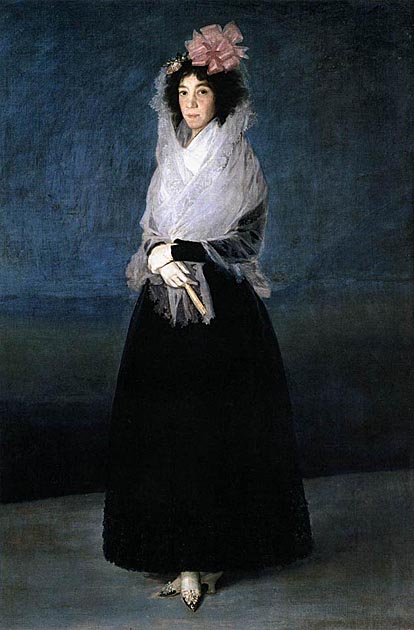
Never the less, despite his belief in the world as an illusion Francisco Jose de Goya y Lucientes was able to capture perfectly the Countess in the Portrait of the Countess del Carpio and "communicate the strength of character of this charitable, cultivated woman, who was still young but very unwell and, knowing herself to be terminally ill." For entertainment and curiosities sake I will post a clip of the painting (Although I wish it could be clearer and smoother to understand its beauty better :(.. oh well).


she really is very pretty..I liked your example
ReplyDeleteWicked link to the class context! Its so interesting how the things we have come to discover today, have been there all along. Not only that, but some people actually grasped this in historical times, many who I can only assume did not have an Intro to Literary Theory class. Simply off moral outlook on how they view the world, and people within it.
ReplyDelete