Monday, April 5, 2010
Reflections
Thursday, March 18, 2010
"Before the Earth Was Round"
Before the earth was round,
There was no end to things
No one tried to measure what they knew
Everything was warm
And everyone would love
And every contradiction was true
The sun worked twice as hard
And the moon was twice as far
And the sky was still honestly blue
The sky was still honestly blue
But when the time came
Everything spiraled in
And everyone forgot what they knew
War became a job
And love became a mystery
And heart and head were bent out of tune
Fear and doubt began
And God threw up his hands
And the sky didn't know what to do
The sky didn't know what to do
The sky didn't know what to do.
http://www.youtube.com/watch?v=MB_zzxcQ86I
It Is Inevitable
In The Matrix, the agents, or machines can jump into any persons body. Because the agents can be anyone, you never really know what you are seeing, or if it is real or a mirage (but who can define what is real now anyways. ?). There is no individuality if the agents can mold each person to take whichever form they choose, and the humans have no say as to whether the agents enter their body or not; the humans cannot fight the technology.
Just like in this digital era, it seems inevitable that eventually no human will be able to live without technology.
It is amazing the capabilities we have now because of technology, but it seems such a sad, sad world we live in that we are so dependant on media that we have a hard time functioning on our own without technology.
I remember report cards back in elementary school, we would get letter grades on how we functioned in the class independantly. Now we would all fail!? This is just one example, and I know that there are people who are still very good with numbers, but you should see how easily people like my Nono (grandpa) put together numbers, just because they didn't have calculators when he was growing up in school. Now I am not even sure if kids these days know what math class is without a calculator...?
Who is Professor Pound, and Is he Really Our Professor?
How does Baudrillard's theory of simulation and the hyperreal work for people?
Is he really suggesting that our Professor is not Actually our professor, and that he is a simulation of what a professor might be?
It is easy to see how people are not really what they are in The Matrix, but not so easy to tell with life outside the movies. For me anyway.
The only way I can explain that Prof. Pound would not really be a professor is by showing that he is a professor, and a dad and a son, a husband, friend, athlete, etc. So therefore which is the REAL him? And since the definition of all of those roles can be conditional and are constructions of our society, those roles could in fact be something other than what they are defined as, and since the terms could be something that they are not, then nobody IS what they really think they are . ? Haha that seems really confusing, but am I on the right track with this? I am not sure if that is exactly how the hyperreal works for humans, or if the hyperreal is not something that can describe humans but only a thing that humans get caught up in.?
Any comments or ideas?
Sunday, March 7, 2010
"No, That's Not Expensive Enough For My Kind Of Taste. That Is Soo Last Season. Hellooo, Ever Heard Of A Brand Name?!..."
These brand names are all social constructions, and sometimes the more expensive items do hold better quality, but it still does not change the fact that logos no longer represent what they were meant to. Take the label Billabong for instance, originally created as a label for surfer products, but most of the people who I know that wear Billabong apparel have never even seen a surfboard in real life. I have to admit that I have been subject to the brand name shopping frenzy a few times but there are becoming more often cases that sit at the extreme. For example, I remember a girl I went to school with in grade 7 that liked to shop in the extreme, and as this was years ago you can imagine how greatly corporate logo fetishes have increased since then.
All of the girls in my grade 7 class, including myself, were in the locker room after gym and I remember saying to one girl, "hey, that's a nice shirt. Where did you get it?". She followed with a thank you, and proceeded to say she received it as a gift and didn't know, so she asked someone to check her tag for her. After she realized the shirt was purchased at Walmart she began to shriek. She ripped the shirt off and threw it on the floor and stared at it with disgust... I hope noone minds me bluntly saying that after that display I stared at her with disgust for her pettiness. I don't criticize anyone for wanting to look nice, or be fashionable, but what is the necessity in spending more than would be required to do it.
The following is an insert from an article by Angela Orend called "Corporate Logo Tattoos: Literal Corporate Branding?." It refers to brand name logos and people who literally tattoo them on their bodies, she also tackles the issue from a Baudrillardian perspective. Enjoy! (p.s. Sorry, I know this is a long one)
"Corporations present products as being representative of certain personalities and lifestyles, consumers fetishize the brand, not the product itself. With brand fetishism, brands represent and become equated with lifestyles as brand awareness and advertising become more important than the product itself (Vanderbilt 1997). In applying the notion of brand fetishism to corporate logo tattoos [literally people who tattoo (that permanent ink stuff) company logos on their body, often in return for payment, or free lunches from that restaurant for the rest of your life for example], the tattoo is an expression of what the brand represents, not necessarily a loyalty to the superiority of the product... Baudrillard insists that we are consuming not the object of the sign, but rather the system of implicit meanings that the object of the sign represents, but the meanings are simulated and meaningless. Within the logic of consumer capitalism, the collective "carnival of signs" prevails as everything becomes a commodified product embedded with meaningless social symbols. If Baudrillard is correct and postmodern consumption is the "active manipulation of signs" where the commodity-sign proliferates, corporate logo tattoos are nothing more than a fashion accessory in the hyperreality of postmodern consumer culture. The human body becomes a multi-dimensional billboard representing another simulated hyperreality. Corporate logo tattoo consumers are not interested in the product or duped by capitalism, they are simply expressing various simulations of reality and have fetishized the social meanings of the brand and commodity-sign logo."("Corporate Logo Tattoos: Literal Corporate Branding?" by Angela Orend).
Gibson Tells Freud and his Penis Envy to Eat It
-(Mel) And another thing.
This thing about penis envy.
-(male Assisstant) Yeah.
-(Mel) Not true. No.
They don't envy it.
Halfof'em
don't even like it.
You know who has penis envy?
We do.
That's why we cheat and screw up and lie,
because we're all obsessed with our own equipment.
Thursday, February 25, 2010
The Sentimental Tradition and Boys Don't Cry
I was planning an essay I was going to write on Black Beauty the other night and suddenly everything I was thinking about seemed to correlate with the movie Boys Don't Cry.
To me, it suddenly seemed as if the movie had been directed under the influence of the Sentimental Tradition - The era that thrived on misfortunes of the misfortunate, weak and the minorities. Sentimental literature tried to bring to attention the mistreatment of these groups; the sentimental tradition looks for change, but never a change that is too drastic that it completely throws off the social order.
We discussed in class how Boys Don't Cry obviously reaches out to the audience to adopt a transgender gaze and sympathize with Brandon Teena, but then just as it seems there could be progress within the social order, Brandon seems to accept his feminine name Teena, and a lesbian scene occurs to bring the complicated movie back down to a level that society can understand better than they could a transgender relationship. Atleast with the lesbian scene, society is able to specifically label that relation as homosexual, whereas a transgender relation is more confusing.
And then in the end, like all active/unpassive characters within the Sentimental Tradition, because Brandon calls attention (even though it is unintentional) to himself and is threatening to disrupt all the norms that society has built, Brandon has to die (Just like Ginger and Seedy Sam in Black Beauty).
Tuesday, February 9, 2010
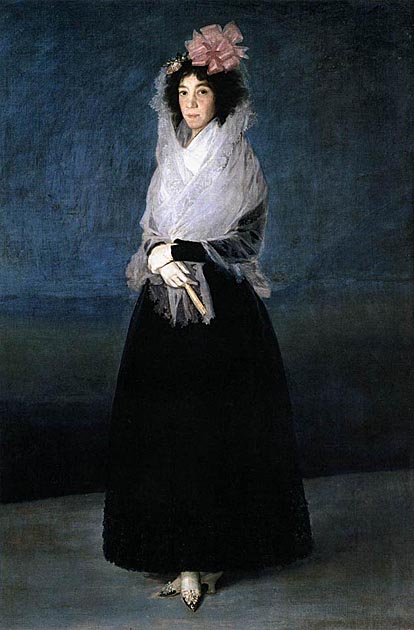
It Is All An Illusion But the Countess del Carpio
Tuesday, February 2, 2010
The F-Word
Just as the terms and meanings of "sex," "sexuality," and "gender" (along with basically all of the others that make up our world) are social constructions and are entirely susceptible to change, I realized that so are the terms that go along with these statuses.
The attached episode of South Park, which in my opinion is fairly comical (*note: the video is mildly controversial, but it is not my intention to upset or insult anyone by adding it), is a validation of my previous statement in the form of a satire. They point out that the term "fag" was used by labourers, and in more recent times has been used as a disparaging term against homosexuals. Homosexuality receives a fair amount of jabs because it is seen as the unnatural sexual preference (which we in Intro. to Lit. Theory class now know to be untrue). "Fag" then became used as a common insult on heterosexuals intended to mock those of "abnormal" sexuality. As of late, "fag" has become an invective, or sometimes even a jesting between friends, word against anyone deemed to be upsetting, or a "loser," without any purpose to harm homosexuals. According to the South Park's "The F-Word" episode, heterosexual "losers" are called "fags," while homosexual "losers" are specified as "gay fags."
Obviously the "f-word" can still be hurtful to homosexuals who have felt its wrath in the past, but this video just shows how arbitrary the term "fag" is and it's insolidity as an insult. So if you have about 20 minutes to spare, check out this link and let me know if you agree with what I am saying :).
http://www.xepisodes.com/southpark/episodes/1312/The-F-Word.html
Monday, February 1, 2010
The Quickest Cure to Racism!

Tuesday, January 19, 2010
Who Carries the Legacy?
Thursday, January 14, 2010
Feminism Banns Psychological Violence
“The law is expected to cover every kind of insult including repeated rude remarks about a partner’s appearance, false allegations of infidelity and threats of physical violence.
Police are being urged to issue a caution in the first instance, but repeat offenders could face a fine, a restraining order or even jail.
Critics said the measure was a gimmick produced in response to lobbying by feminists and would be impossible to implement.
But French premier Francois Fillon, who announced the law, said: ‘The creation of this offence will allow us to deal with the most insidious situations – situations that leave no visible scars, but which leave victims torn up inside.’”
I just thought this was an interesting instance of feminism that I could share.